
The International Station of Canfranc: 100 years of history in the middle of the Pyrenees
A 241-metre railway palace built in a valley of 500 inhabitants. It was the most ambitious station of its time, a border of spies in the Second World War and a ruin for decades. Today it is a luxury hotel — and you can see inside.
The International Station of Canfranc opened in 1928 in the Aragón valley (Huesca) to link Spain and France by rail through the Somport. Because each country used a different track gauge, everyone had to change trains there: hence a building with 241 metres of façade and 365 windows. During the Second World War it was a route for wolfram and Nazi gold, and also an escape route for hundreds of people, with the French customs officer Albert Le Lay as the key figure. The line was cut in 1970 when the L’Estanguet bridge collapsed and the station was left abandoned. Restored, it reopened on 27 January 2023 as the Canfranc Estación, a Royal Hideaway Hotel (Barceló Hotel Group), with 104 rooms. You can see inside on guided tours from €15.
In this guide
Why such an enormous station in such a small valley1928: kings, presidents and a train almost nobody usedThe Second World War: "the Casablanca of the Pyrenees"Albert Le Lay, "the Schindler of Canfranc"1970: the bridge that changed everythingThe hotel: Canfranc Estación, a Royal Hideaway HotelHow to visit the Canfranc Station todayFrequently asked questions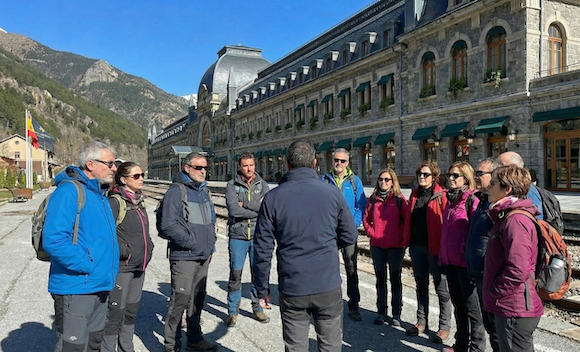
Why such an enormous station in such a small valley
The answer comes down to two words: track gauge. Spain built its railway network on a wider gauge than the European one, so no French train could carry on into Spain, or the other way round. At the border, every passenger had to get off and every piece of freight had to be transferred from one train to another, with two customs services, two police forces and two administrations doing the paperwork at once.
You do not solve that with a halt: you solve it with a city under one roof. The building is 241 metres long and 12.5 wide, with 75 doors on each side and 365 windows — one for each day of the year, as local tradition has it. From the outside it looks like a nineteenth-century French palace; inside it was a logistics machine of concrete, stone, iron and glass, under slate roofs.
For decades it was described as "the second largest station in Europe", behind Leipzig. The comparison is arguable, but it gives a fair sense of the ambition behind the project.
1928: kings, presidents and a train almost nobody used
The station was inaugurated on 18 July 1928 by King Alfonso XIII and the French president Gaston Doumergue. It was the culmination of decades of work: the Somport tunnel, the viaducts, the platform carved out of the valley — all to connect Zaragoza with Pau and, in theory, put the Aragonese Pyrenees on the map of European trade.
The traffic never lived up to the building. The Spanish Civil War closed the line, and by the time it reopened the world had changed: Europe was going to war, and Canfranc stopped being a commercial promise and became something far murkier.
The Second World War: "the Casablanca of the Pyrenees"
Between 1940 and 1944, with France occupied and Spain officially neutral, Canfranc was one of the few gaps left open between Nazi Europe and the outside world. Across its platforms went the wolfram that Franco's regime was selling to the Third Reich — a mineral essential for armour and ammunition — and, in the other direction, gold looted by the Nazis that paid for it.
Across those same platforms, and often on the same trains, went Jews, Allies, downed pilots and refugees fleeing the occupation. Spies from both sides lived in the village. Hence the nickname that stuck: the Casablanca of the Pyrenees.
Much of this history came to light late. In 2000, boxes of French customs paperwork — delivery notes, freight records — turned up in the station itself, making it possible to reconstruct the real scale of that traffic.
Albert Le Lay, "the Schindler of Canfranc"
Albert Le Lay was the head of the French customs post in Canfranc. His office was inside the station, on the French side of the building, and his signature decided who crossed and who did not. Le Lay used that power for the opposite of what was expected of him: he provided papers, looked the other way and organised crossings for hundreds of people fleeing Nazism. In the end he had to flee himself.
His story is now the heart of the theatrical tour of the Canfranc Station: an hour and a half in which an actor steps into Le Lay's shoes and walks you through the very spaces where it all happened. It is the most direct way to understand what was at stake here.
1970: the bridge that changed everything
The end came by accident. In 1970 a freight train derailed on the French side and took the L’Estanguet bridge down with it. France, which had long considered the line loss-making, decided not to rebuild it. Without the bridge there was no international connection, and without an international connection the station had no purpose.
What followed was thirty-odd years of abandonment: leaks, broken glass, pigeons and a façade falling apart while the building became a pilgrimage site for photographers and urban explorers. In 2002 it was declared a Site of Cultural Interest, the step that made everything afterwards possible.
The hotel: Canfranc Estación, a Royal Hideaway Hotel
The restoration, driven by the Government of Aragón, brought back the 1928 structure and façade and adapted the interior to a new use. On 27 January 2023 the building reopened as the Canfranc Estación, a Royal Hideaway Hotel, the luxury brand of the Barceló Hotel Group: 104 rooms — 4 of them suites — on the first and second floors, with the ground floor given over to the wellness area with a heated pool, the library and the main restaurant, for which period carriages were restored.
The result is unusual and very good: a hotel where the room corridor is literally the building of an international railway station, and where the concourse is still the concourse the trains of 1928 passed through. That the building now has an economic use is also what guarantees it stays standing.
You do not have to stay there to see inside: the guided tours go into the building and cover both the interior and the railway grounds.
How to visit the Canfranc Station today
There are three ways to see it, and they complement each other well:
- Special guided tour: 1 h 30 min with a local guide, 8 stops through the interior and the railway grounds, and access to restricted areas that the standard tour does not reach. From €15 per person. The default choice if you are only doing one.
- Theatrical tour with Albert Le Lay: 1 h 30 min with an actor playing the French customs officer. From €18. Run in Spanish only.
- Paseo de los Melancólicos and the bunkers: about 2 h on foot along paths and through woodland, with the best exterior views of the complex and an explanation of why the valley filled up with fortifications. Private tour from €40.
Canfranc-Estación is in the Aragón valley, about 25 km from Jaca and next to the Somport tunnel. If you are coming for the day, the usual plan is to combine a visit to the station in the morning with a mountain activity in the afternoon: hiking in summer; snowshoeing or skiing in Astún and Candanchú in winter.
Frequently asked questions
Can you visit the International Station of Canfranc?
Yes, with a guide. The building is now the Canfranc Estación, a Royal Hideaway Hotel (Barceló), and it is visited on guided tours. The special guided tour lasts 1 h 30, covers the interior and the railway grounds in 8 stops and reaches restricted areas. From €15 per person.
Why is the Canfranc Station so big?
Because Spain and France used different track gauges and every passenger and every piece of freight had to change trains there. That required a building with 241 metres of façade, 365 windows and 75 doors on each side, with both countries' customs services and warehouses under the same roof.
When did it open and when did it close?
It opened in 1928 with Alfonso XIII and the French president Gaston Doumergue. The international line was cut in 1970, when the L’Estanguet bridge collapsed on the French side. It has been a Site of Cultural Interest since 2002.
What happened in Canfranc during the Second World War?
Across its platforms went the wolfram Spain was selling to the Third Reich and gold looted by the Nazis, and at the same time hundreds of Jews and others fleeing occupied France. The head of the French customs post, Albert Le Lay, helped them cross: that is why he is called "the Schindler of Canfranc".
Is it a hotel today?
Yes. It opened on 27 January 2023 as the Canfranc Estación, a Royal Hideaway Hotel, part of the Barceló Hotel Group, with 104 rooms (4 suites), keeping the original 1928 structure and façade.